

If you feel the pull of unknown coastal roads and rugged terrain, all you have to do is head north in Ireland, toward the mythical cliffs of the Causeway Coast. Continue along the Wild Atlantic Way in Donegal and Mayo.
The Irish are proud of their Wild Atlantic Way, often described as the world’s longest continuous signposted tourist route, winding along Ireland’s west coast for 2,600 kilometers. Ireland seems made for those of us who crave adventures. If I had only one holiday left in my life, I would probably end up here.
Causeway Coast
We begin our coastal journey in the far north, on the Causeway Coast in Northern Ireland, after a three-hour drive from Dublin Airport. Here we visit Dunluce Castle and the Giant’s Causeway, the extraordinary black cliffs made up of 40,000 dark basalt columns in County Antrim. Famous film productions shot here on the north coast—also known as the Antrim Coast—include Game of Thrones and Hellboy II. Scientists say the hexagonal columns were formed by lava 60 million years ago.
Irish legends, on the other hand, tell that the giant Fionn mac Cumhaill (Finn MacCool) built the Giant’s Causeway as a kind of oversized cobbled road all the way to Fingal’s Cave on Staffa in Scotland. This was so he wouldn’t get his feet wet every time he went to beat up Scotland’s leading giant, Benandonner. Some say Fionn is not dead—he is merely sleeping in a cave. One day, when Ireland is in its deepest need, he will awaken and defend the homeland. Who knows—perhaps that day will come soon!
After our geological expedition, it’s time to head to the nearby world-famous whisky distillery in Bushmills, where you can also stay at the cozy Bushmills Inn. It’s convenient to be able to walk a short distance (if you remember the way) from the distillery back to the hotel.
Wild Atlantic Way from the North
When we reach Derry (“Londonderry,” according to the British), the official Wild Atlantic Way route begins. You can follow it all the way to Cork in the southwest. From Derry, we first drive northwest. People think of the Republic of Ireland as the “south” of the island—but the north coast of County Donegal in the Republic of Ireland is as far north as you can get. Ballyliffin lies just a half-hour drive from the mainland’s northernmost point at Malin Head.
At Malin Head there is also a well-known attraction—the ancient stone structures there were used in recent Star Wars films. During filming, white “stormtroopers” could suddenly appear anywhere in the village, whether on the beach or playing billiards in local pubs (they popped up in many an Instagram feed).
Donegal
County Donegal is often regarded as the country’s forgotten corner (“Ireland’s Forgotten County”). Perhaps that status makes it even more appreciated by those who make the journey and experience the refreshing lack of crowds.
The landscape around Ballyliffin is inspiring. There are not many straight roads up here. The Atlantic Ocean lies to the north, and if you travel by boat from here in a northeast direction, you soon reach Scotland: Islay, the Kintyre Peninsula, and Arran. This is Ireland’s “outback.”
Everywhere we go, we are met with overwhelming friendliness. Live music and Guinness are just two of the advantages of an Irish holiday. It doesn’t hurt that the Irish are known for being highly sociable. Most people make at least three new friends along the way—often without even trying.
“When someone comes to Ireland, they become members of the family,” says Irishman Pat Ruddy. New friendships are formed—and can last for decades.
History and Landscape
Our next attraction is Grianán of Aileach, a 1,500-year-old circular stone fort. For those who want to immerse themselves in ancient times, à la Game of Thrones, it’s a perfect excursion. The northern kingdom of Uí Néill built the fort in the 6th century AD. Inside the walls there was once an entire settlement, including livestock.
The Irish have a fascinating history, but it is the landscape that has the strongest impact on me. From Rosapenna in the north to Enniscrone and Belmullet in County Mayo, the beaches can take your breath away. I’m thinking especially of Narin, where the beach is wide and white, and the water has an exotic turquoise color, almost like something from a Caribbean travel brochure.
At Mount Falcon Estate, a short drive from the village of Ballina, we experience an elegant Irish “castle,” where activities range from clay pigeon shooting, trout fishing, and falconry displays to a round of golf on one of Ireland’s 400 golf courses.
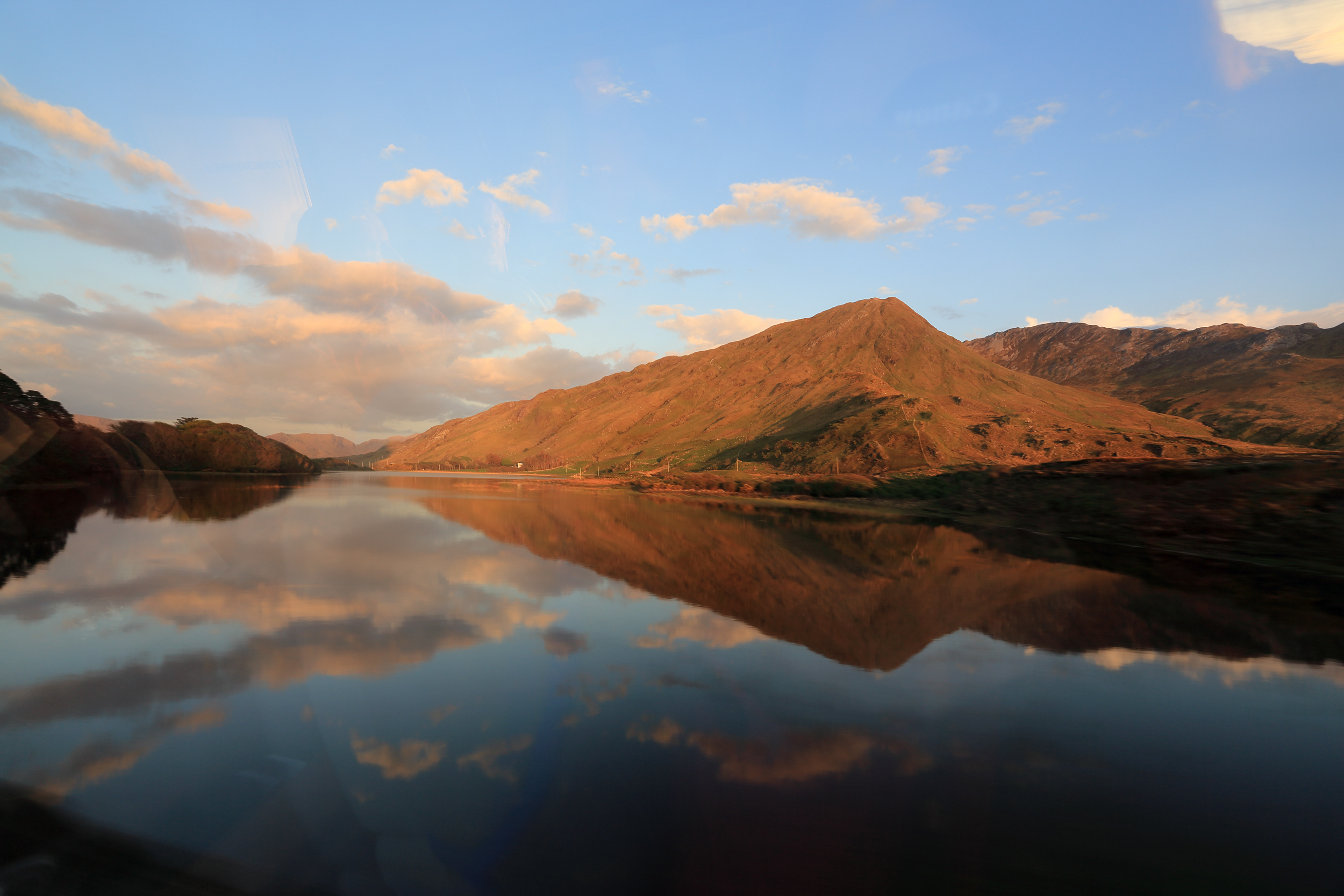
Eventually we reach “Ireland’s only fjord”—Killary Harbour, which stretches 16 kilometers inland. Granted, we have more dramatic fjords in Norway, but still. There is something gentle and welcoming about this Irish fjord landscape.
After 800 kilometers from Dublin, and 500 kilometers along the Wild Atlantic Way, we must return to the airport. Next time I’m in the area, I’ll travel all the way to the mythical Achill Island. It is said to be one of the 365 islands in Clew Bay—one island for each day of the year. Perhaps we should count them to be sure? It sounds like a plan.