
We had no idea Swedish castles could be a road trip theme of their own. That is until we started plotting a castle route. We drove south from Oslo toward West Sweden, looking forward to a luxury weekend at castles and manor houses.
Four castles, eight centuries
West Sweden isn’t the country’s obvious castle territory — Skåne and the area around Stockholm usually get that reputation. But Västergötland and Bohuslän have some of Sweden’s most striking estates, scattered around Vänern, the country’s largest lake and the third-largest in Europe. The quartet of “castles” on our list span eight centuries: a medieval bishop’s fortress, a 17th-century Baroque powerhouse, a Victorian-era foundation with a genuinely international legacy, and a shipyard baron’s Gilded Age fantasy.
On paper, this is a “castle safari.” In practice, we experience four very different forays, and hear the stories about money, power, and what people do with both once they have them.
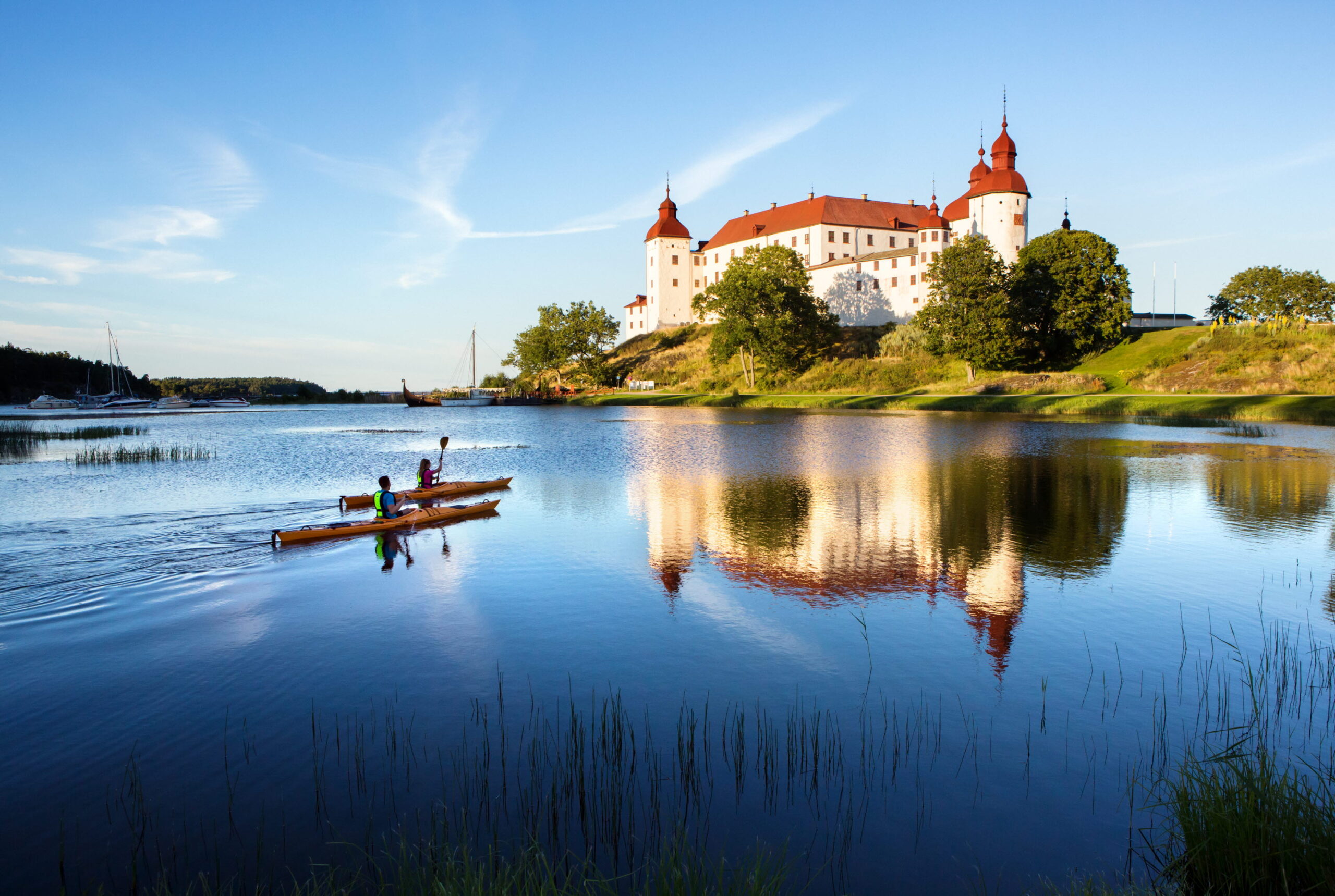 Läckö castle and kayaks (Photo Roger Borgel / West Sweden Tourist Board)
A stately weekend in West Sweden
The plan, roughly: the drive from Oslo to Bjertorp Slott takes about four and a half hours. From there it’s another hour and a half north to Läckö Slott on Vänern. After the visit there, we head south for a light lunch at Dahlbogården Event & Rum, then on to Nääs Slott, just outside Gothenburg. On the way home, we stop at Thorskog Slott before crossing back into Norway. Three days, two nights, four castles.
Several of these places, including Dahlbogården, belong to Hållbarhetsklivet, a regional sustainable-tourism initiative run by the West Sweden Tourist Board (Turistrådet Västsverige). Businesses that join commit to four things: keep their environmental footprint down, benefit locals as much as visitors, help spread tourism to quieter places and off-peak seasons, and build real, year-round jobs rather than seasonal ones. It’s a useful shorthand for the kind of places this trip kept landing on.
Bjertorp Slott in Kvänum sits in genuinely grand surroundings.
Our first stop is Bjertorp, an Art Nouveau castle on the Västgöta plain in Västergötland, designed by the celebrated architect Ferdinand Boberg. It was built as a private residence for Consul Knut Henrik Littorin — who, fittingly for a story full of odd details, really was Norway’s consul in Moscow during the union years with Sweden.
The main building went up between 1911 and 1914 to Boberg’s designs, and today it’s considered one of the best-preserved Art Nouveau environments in Sweden — a 1,954-square-metre residence with granite foundations quarried in Bohuslän, limestone façades from Falköping, and materials and craftsmen brought in from across Europe. Littorin had apparently tried to hire Boberg once before, and been turned down flat: the architect said he’d rather spend his time on grand public buildings in Stockholm than fuss over a country house. But when Littorin told him he could name his own fee, Boberg changed his mind — and, according to castle lore, promptly doubled the scale of his own drawings on the spot, after his wife complained the original plans looked too modest.
The money to build it all came from oil and gas in Russia. Littorin had started at the bottom — office boy — in Nobel’s Russian oil operation and worked his way up to manager and board director, becoming close enough to the Tsar’s circle to smuggle gold bars home to Sweden by horse and cart. When the Bolsheviks came for him in Finland in 1917, he escaped only by swapping places and clothes with his coachman, who was shot in his place.
The first thing you meet in the entrance hall is a stuffed Russian bear, reportedly shot by Littorin himself and brought home from Russia as a trophy. Inside, the rooms carry the story further: a “Kremlin Salon” modelled on a room in a Russian imperial palace, a Yellow Salon lined with French silk wallpaper and furniture Boberg designed himself, and a dining room panelled in Honduran mahogany with Italian stucco work overhead.
The castle stayed in the family until 1956, when it became a school. In 1980 it was converted into a hotel and restaurant. Today Bjertorp is known for its striking Art Nouveau architecture and its park, and it’s become a popular venue for weddings and romantic weekends. It’s part of both Hållbarhetsklivet and the Smaka på Västsverige food network.
Läckö Slott: history, art and drama on Lake Vänern
Läckö Slott sits on Vänern and is one of West Sweden’s most visited destinations, with a history stretching back more than 800 years. Bishop Brynolf Algotsson laid the first foundations of a fortified castle here in 1298, and the site went on to serve as a pilgrimage stop within the diocese. A fire in the 1470s prompted Bishop Brynolf Gerlachsson to rebuild and expand it; after the Reformation in 1527, King Gustav Vasa took the castle under crown control, and it fell into disrepair until Svante Sture’s family began restoring it.
Kungssalen (the King’s Hall) at Läckö Slott is a serious experience.
The castle passed through several dramatic hands after that — including Hogenskild Bielke, a shrewd 16th-century business figure who received Läckö as a barony in 1571 through marriage and assembled one of the largest private book collections in Sweden of his time, before being executed in 1605. But the castle we see today is overwhelmingly the work of one man: Magnus Gabriel De la Gardie, the nobleman, politician and military commander whose family took control of the fief in 1615. Taking charge at just thirty, and married to Maria Eufrosyne — who at one point personally owned more than a thousand taxed farms across Sweden and the Baltic provinces — De la Gardie began a construction campaign in 1654 that added new wings, servants’ quarters, a kitchen bailey, a castle church and an entire fourth floor, along with the elaborate Baroque decoration that still defines the building. Läckö’s uniquely preserved Baroque halls and 248 rooms have made it, in one national poll, the castle the Swedish public voted the most beautiful in the country.
During summer, Läckö hosts concerts, opera and guided tours. Just a few metres from the castle stands Naturum Vänerskärgården — the Victoriahuset, a visitor centre with exhibitions on the Vänern archipelago and Djurö National Park. It was inaugurated in 2013 as a gift to Crown Princess Victoria, and with fifteen hotel rooms and a restaurant attached, it makes a good base for a castle visit.
Fredrik Kindberg, Läckö Slott’s leading historian, shows us the castle’s original key.
The highlight of our visit is a private tour with Fredrik Kindberg, Läckö’s foremost historian, and a descendant of the brother of a Catholic bishop who fled to Germany after the Reformation. Fredrik walks us through a selection of the castle’s 248 rooms, including the magnificent Kungssalen (King’s Hall), decorated with grand 17th-century history paintings from the era when Sweden became a European great power and Magnus Gabriel De la Gardie made his name on the continent’s battlefields.
He takes us further, to a well that conceals a secret escape route down to the water — where a boat was once kept hidden among the reeds — and to the dungeon, where people accused of witchcraft, treason or murder were held for months, sometimes years. Fredrik tells us that Magnus Gabriel eventually grew so tired of campaigning across Europe that he came home wanting nothing more than a peaceful family life at Läckö — and that he took far more pleasure in releasing prisoners from the dungeon than in putting new ones in.
“I get the feeling you like Magnus Gabriel — you’re defending him,” I say.
“Well, that’s my job!” Fredrik says, with a wry smile.
Läckö is today owned by the Swedish state and managed by the National Property Board.
Nääs Slott: heritage and a love story
Nääs Slott
Our next stop is Nääs Slott, where we spend the night in one of the old guest houses on the grounds. Nääs isn’t about fortresses or medieval sieges — it’s about a very specific, beautifully preserved slice of the 19th century.
August Abrahamson, the man behind Nääs, was born in 1817 in Karlskrona to German-Jewish parents and built a fortune in Gothenburg trading small imported goods — buttons, thread, shirt collars, gloves — from Germany, England and France. At fifty, in 1868, he bought the Nääs estate together with his wife, Euphrosyne Lehman, an internationally recognised opera singer who died just a year later. In 1872 Abrahamson founded a handicraft school for boys on the estate, followed soon after by a workshop for girls — the beginning of what became the Nääs sloyd teacher seminary, which trained handicraft teachers from around the world and went on to influence educational reform across Europe, remaining in operation until 1966.
Detail from August Abrahamson’s bed, where he died on 6 May 1898.
After Abrahamson’s death in 1898, the castle — furniture, interiors and all — was preserved almost exactly as it had been, like a kind of time capsule. In 1901, to guarantee the school would outlive him, he had already converted the estate into a foundation, which still manages the property today.
The author Selma Lagerlöf was the life partner of Abrahamson’s niece, Sophie Elkan, and the two women often spent weeks at a time at Nääs — sometimes in the very guest house where we spend the night, other times in one of the bedrooms in the main castle, next to the grand ballroom on the second floor.
The factory kitchen at Nääs Fabriker.
We end the day at Nääs with dinner at Fabriksköket, in Nääs Fabriker, where the old textile mill has been turned into a lively cluster of shops, cafés and restaurants. The restaurant itself occupies the old factory hall — high ceilings, big factory windows, and a genuinely good atmosphere.
Thorskog Slott: the last stop before home
Thorskog Slott
On the drive back to Oslo, we stop at Thorskog Slott, built in 1892. The estate itself goes back further: from 1738, Olof Wenngren developed it into an ironworks, laying out the English park and dam system that still shapes the grounds today. It was Petter Larsson — a shipyard baron who grew up poor in Åmål and built an industrial fortune from nothing — who put up the castle building itself in 1892, giving it the air of an English country house with distinctly Swedish detailing: turrets, bay windows and verandas looking out over green meadows. After Larsson’s death in 1912, the estate passed through several owners before a family bought and restored it in the early 1970s; today it operates as a hotel, restaurant and event venue with forty rooms. This is a place you could happily stay a little longer than a night.
Famous guests are said to include George H.W. Bush, who reportedly stayed at Thorskog during a summit of world leaders in Gothenburg while he was U.S. president. On the guided tour, we’re shown the wine cellar — five dusty French wine bottles sitting behind a locked grille. The story goes that Bush had brought the bottles with him, and had this little niche dedicated to storing them. When he left, he took the key with him. Ever since, the staff at Thorskog say they’re still waiting for Bush to come back for his wine.