

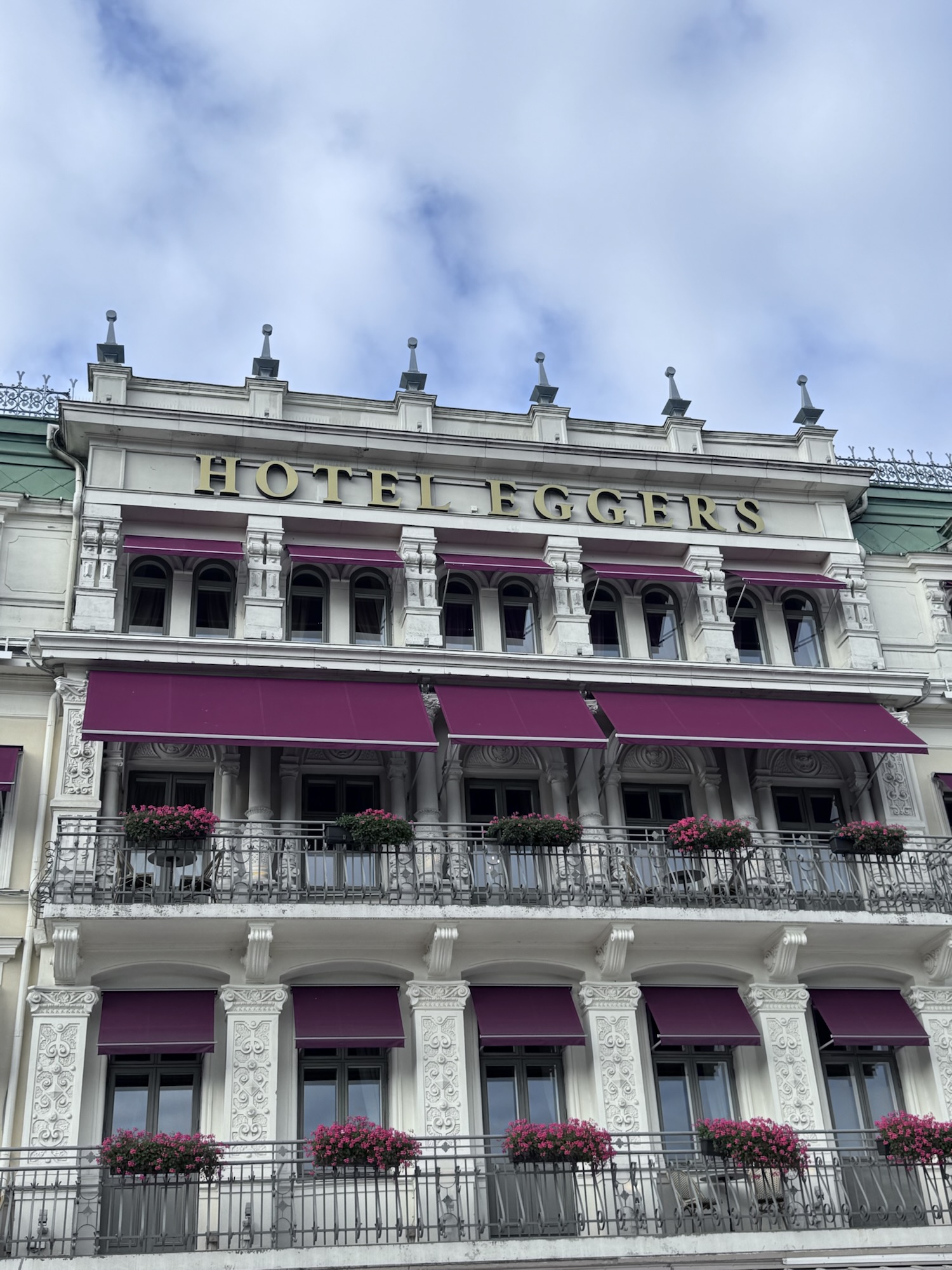
The lift at Hôtel Eggers has been carrying guests since 1893. Emil Eggers installed it when he reopened the Gothenburg hotel with electric light, a telephone in every room and twelve private bathrooms. The lift was actually one of the first to be installed in the city.
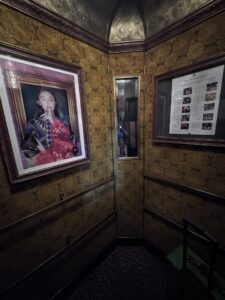
A crystal chandelier hangs inside the tiny lift, the walls are lined in gold damask, and the floor is leopard print. If you’re not claustrophobic, just taking the lift is a bit of a historic joyride. You see the old-fashioned iron gate close and the lift slowly rise. You may (if your mind works like mine) wonder about all of the famous people who’ve been in the lift, and perhaps what shenanigans have happened in it – after all, there’s not much room for more than a very romantic couple inside.
Claustrophobes, not to worry: the hotel has a spiral staircase, equally old, for anyone who prefers to walk.
This is the most historic hotel by far in Gothenburg, Sweden. It’s also one of the three oldest hotels in Sweden still in business. Dignitaries, royalty (Swedish and others), shipowners and travelling salesmen have had this place as a favourite haunt for more than 160 years.
Room 136
The legendary tenor Jussi Björling always stayed in room 136. Once, a female colleague got there first. Björling was so appalled that he checked into a different hotel. They never made that mistake again! Norwegian skater and Hollywood star Sonja Henie always stayed in room 386 when she brought her ice shows to Ullevi, and fans packed the square so tightly that she needed a police escort to reach her room.
The guest list hasn’t stopped. Håkan Hellström, Gothenburg’s own pop poet, filmed his first music video in room 133. The Björn Borg movie Borg filmed in room 265, and the television drama Vår tid är nu used the lobby and corridors to stand in for a Stockholm restaurant dynasty. People have been dancing under the dining-room chandelier since 1927.
Also read about A castle road trip through west Sweden
And Room 255…
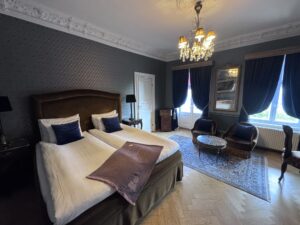
As far as I know, I am the only well-known person to have stayed in room 255 (well-known to me, that is). But I guess my research is lacking. There must be untold stories that the walls would recount if they could. The ceiling had a plaster rose, a fine chandelier, and a cornice running all the way round. The walls are a deep blue-grey, the curtains heavy blue velvet. Two fringed tub chairs sit on a Persian rug by the window, and outside the passing trams make a bit of a rumble.
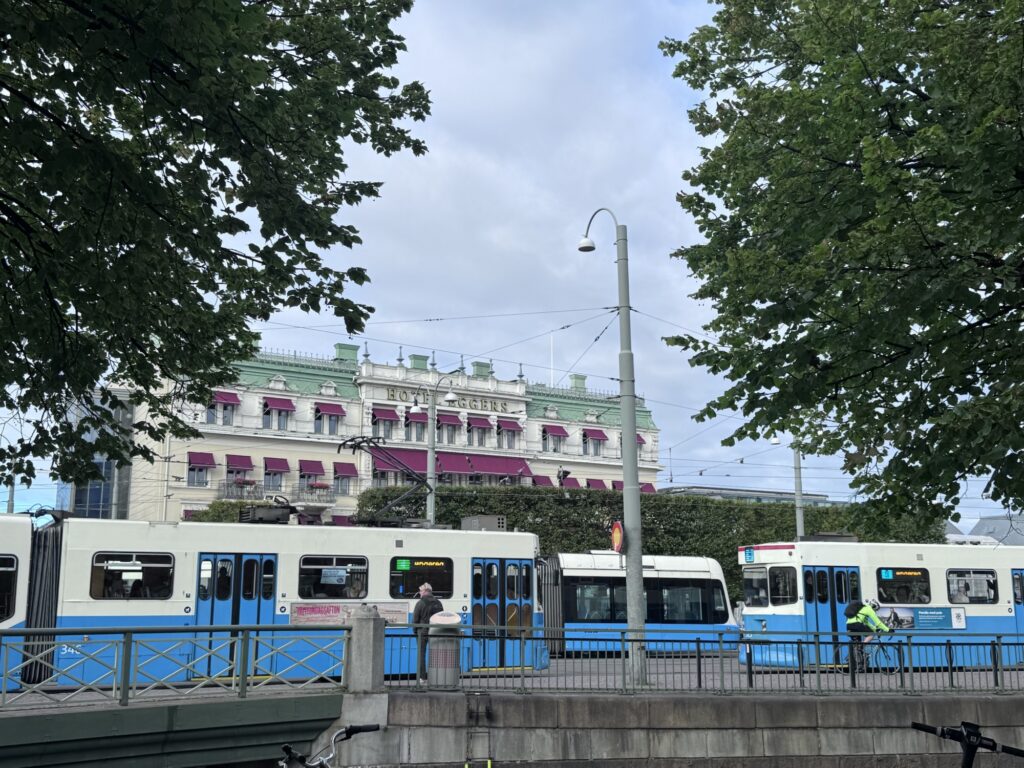
Drottningtorget, the square outside, is one of Gothenburg’s busiest tram junctions, and the blue-and-white carriages rattle past every few minutes. This hotel was built for people in transit.
In the nightstand, where I expected a Bible, I found a thick book bound in red and gold, the hotel’s own history.
Built for the train
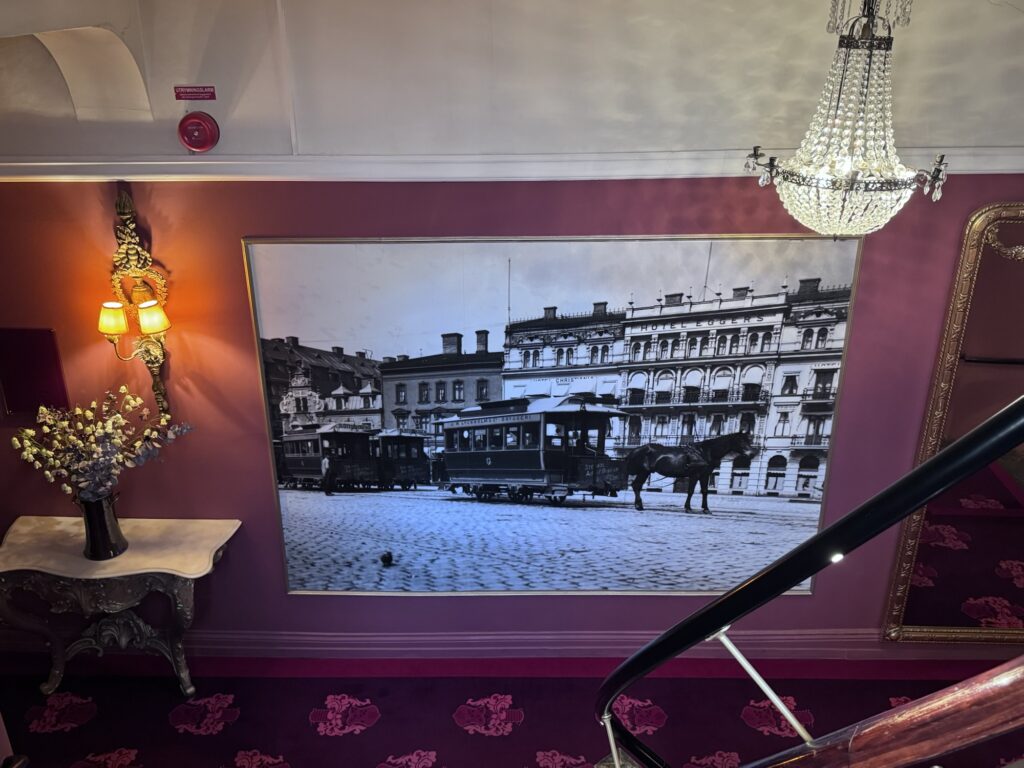
Gothenburg’s first stretch of railway opened in December 1856. Three years later a railway hotel went up beside the station. When the Stockholm-Göteborg line was finished in 1862, King Karl XV rode the first train, leaving the capital at 8:54 in the morning and reaching Gothenburg late the next evening, after a triumphal journey past flag-draped stations. So the hotel had a prime location. But at that point, the hotel was yet to be named Eggers.
A waiter from Bonn
Emil Eggers was born in Bonn in 1850. His father wanted him to go to sea. He chose hotels instead, trained in Bremen, Brussels and Paris, and arrived in Gothenburg in 1876 as head waiter at a rival establishment. In 1883 he took over the old railway hotel, by then a modest three-storey house called Hotel Christiania.
Christiania turned out to be a crowded name. Gothenburg was the departure point for emigrants bound for America, and cheap lodging houses around the station started calling themselves the new Hotel Christiania. So Emil rebuilt, expanded, installed the new lift in 1893 and in 1894 reopened under his own name.
The building was already drawing a certain crowd. In 1886, artists Carl Larsson, Anders Zorn and their fellow rebels chose it as the place to found their artists’ union, Konstnärsförbundet. A large painting in the dining room marks the occasion.
The flagpoles
Emil’s son Axel took over in 1910 and ran the hotel for 32 years. In the mid-1930s, Germany’s envoy in Stockholm, the Prince of Wied, announced he would visit Gothenburg and stay at Eggers. Courtesy at the time meant raising the swastika flag. Axel would not do it, out of conscience and regard for his many Jewish guests. Instead he had every flagpole on the building taken down and sent away for painting. The story goes that they stayed at the painter’s for the rest of the war.
Neutral ground
Across the square stands the old post office. When it was finished in 1925, it was the largest in the Nordic countries and the most expensive building Sweden had ever built. During the Second World War, the Germans rented a large part of it as their Swedish headquarters.
That put Eggers in an interesting position. Sweden was neutral, Norway was occupied, and the hotel bar sat directly opposite German headquarters. It became a natural place for quieter conversations between nations. Rumours of prisoner exchanges on the hotel’s neutral ground have never been confirmed. The staff at the time surely knew more than they said.
Half a month’s wages
After Axel died in 1942, the hotel was run by his second wife, Ebba, the former cashier from the spirits counter. She ran it with an iron hand. Staff paid out of their own wages for anything broken in the guest rooms, and a new soap dish could cost a chambermaid nearly half a month’s pay.
On 26 January 1947, Ebba boarded a KLM flight at Copenhagen’s Kastrup airport on her way to a restaurant fair in Paris. The plane crashed on take-off, killing everyone on board, including the Swedish crown prince’s son, Prince Gustaf Adolf. With her went the Eggers family’s era at the hotel. Axel’s son Olle, who had wanted to be a concert pianist and played Chopin every evening, eventually sold the hotel.
Current owners
The current owners, Lars-Olof Oskarsson and Anna Riis, took over in 2015 and leaned into their history. You see it everywhere. Two grand Eggers men look down from oval portraits behind the reception desk. The staircase carpet is woven with the hotel crest, a beehive over crossed keys.
Tram 11
I slept straight through the trams. At seven I pulled back the velvet curtains and saw the city bustling below my balcony: commuters hurrying across the square, bicycles weaving between them, tram 11 to Saltholmen waiting at the platform.
Next time I’ll come down from Oslo for a night at the opera. La Traviata is playing at the Göteborg opera this autumn, and just maybe I will see the next Jussi Björling, either on stage or checking in to room 136.
Hôtel Eggers at a glance
- Address: Drottningtorget 2–4, Gothenburg, next to Central Station. About 20 minutes by car from Landvetter airport.
- Stars and rooms: 4 stars, 69 rooms.
- Price: Packages from SEK 1,345 per person (one night, breakfast and a bistro dish). Room rates vary by season, so check the booking page. Prices checked October 2026.
- Breakfast and dining: Breakfast buffet daily, a restaurant, the American Bar from 1884, and a lobby bistro with the famous shrimp sandwich.
- Parking and getting there: Östra Nordstan garage, SEK 195 per day. Trams stop outside.
- Pets: Dogs welcome, SEK 300 per stay.
- Owner: Lotus Hotel Group, family-owned, with Anna Riis and Lars-Olof Oskarsson as owners since 2015.
- Book: hoteleggers.se, +46 31 333 44 40, info@hoteleggers.se
The Best Escapes was invited on this trip by West Sweden. Lotus Hotel Group, which owns Hôtel Eggers, also hosted a stay at Billingehus. All opinions are my own.
For more info see vastsverige.com