

Mallorca has everything most of us crave when we’re looking for a warm and welcoming haven.
Mallorca has mountains and gorgeous scenery, beaches and sea, food and wine, and greens that roll true, one after another. But the island has also carried a less flattering reputation: Brits, Scandinavians and other northern Europeans letting loose in the most “exuberant” ways. Heavy partying isn’t everyone’s idea of a good holiday, and over the past decade or so Mallorca has cleaned up its act considerably. The authorities have cracked down hard, and today the rowdiest scenes are largely corralled into Magaluf, where you’ll now find strict caps on all-inclusive drinks, bans on street drinking and pub crawls, and party boats kept on a short leash.

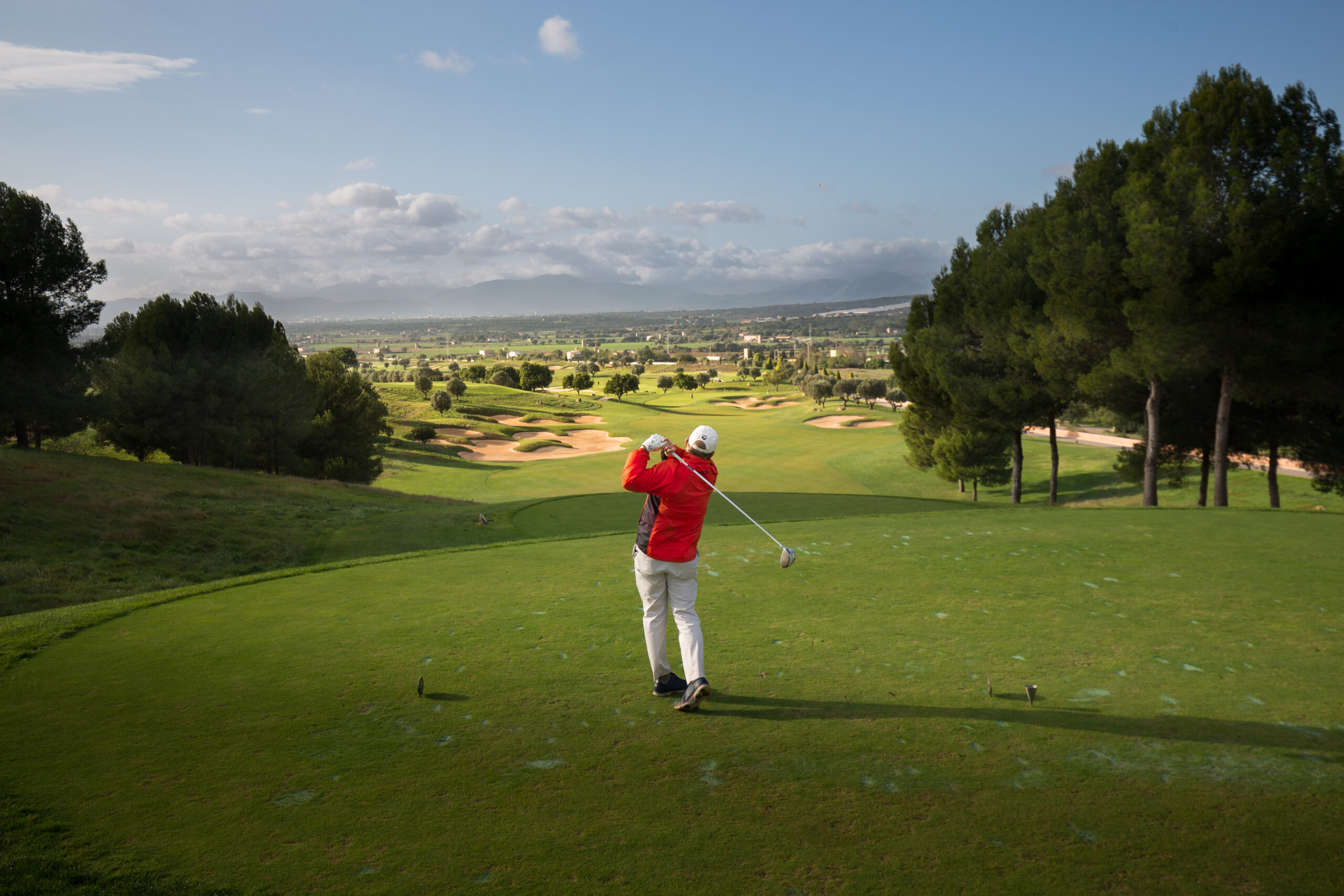
The island has a genuinely staggering 24 golf courses to choose from, packed into a remarkably compact area (to match that density, you’d have to go to the Costa del Sol or Surrey). Wherever you are on the island, it’s never more than 90 minutes to wherever you’re going, and if you stick to the Palma area, everything is within half an hour.
Then there’s the untouched, wilder side: the Serra de Tramuntana mountains and world-class beaches are, naturally, a huge plus. The almond trees in bloom are worth an entire festival every spring, and Mallorca has around five million of them (trees, that is, not festivals). Add an elegant capital with lovely shops, charming villages, Roman ruins and an enormous medieval cathedral, and you start to see the appeal.
Playground for the upper crust
The island was already a British playground back in the 1920s: peaceful, and open to creative types who wrote poetry by day and played tennis at the Royal Lawn Tennis Club in El Terreno, just outside the capital, Palma, by evening.

The bohemians were far from unsophisticated; they were the sort who loved dressing for dinner. But in 1931, when the peseta collapsed, the first scheduled flights landed on Mallorca, bringing with them hordes of Americans who drank spectacular quantities of spirits. They wanted, it’s said, to live like characters in a Hemingway novel. By 1935, the island already had 135 hotels.
Let’s skip the next eighty-odd years of mass tourism. The point is that Mallorca is now firmly back on the rise among culture-loving, travel-hungry visitors. Naturally, there has always been a slice of Mallorca that was purely about wealth. The seriously rich have long had their own enclaves, tucked away from the crowds, and the marina in Palma still displays an astounding number of superyachts.
But forget the super-rich; you don’t need much in the bank for a week of good experiences on Mallorca. You can hike for days in the Serra de Tramuntana; the village of Sóller has become a hub for those who like to get around on nothing but the “apostles’ horses,” as the Norwegian saying goes, meaning their own two feet. Along the north coast near Alcúdia, there are more trails to follow. And, of course, there’s a golf course for every mood.
When Son Gual opened in 2007, Europe rediscovered Mallorca as a golf island. The course quickly earned its place among Spain’s finest on the well-regarded Top 100 Golf Courses rankings. Alcanada, on the island’s northeast side, was already there.
Golf course grapes
It’s just a quarter of an hour’s drive north from Palma to Son Gual. German investor Andreas Pamer, who built the course, says the goal is to be considered one of the best in Spain, full stop.

Designer Thomas Himmel has laid out a course that’s pleasant but occasionally demanding, one that isn’t punishing to walk (the distances between greens and the next tee are relatively short). On a few holes, a wayward shot lands you among the vines. Do they make wine from golf course grapes?
Play from the back tees and you’ve got a hard day ahead of you: 6,620 meters, and still only a par 70. As we play, the wind properly picks up; the elements have their say here on Mallorca too. There are six tee options, so choose wisely.
The island’s other courses may not be quite so spectacular, but they’re still good, solid golf, and I genuinely liked every one of them. Puntiro (these days operating under the T Golf banner, as T Golf Palma Puntiró) is a Nicklaus design that opened in 2006.
“I remember when they built the course,” a local golfer told me. “They had to clear enormous rocks from the whole area. It was an unbelievable job.” You can see exactly what kind of rocks got left behind the moment you hit into the rough.
Today, Puntiro is in good shape, especially the greens, which roll fast and impressively true; that was probably the best thing about a course that’s otherwise fairly flat (easy on the legs!) and a fairly classic Nicklaus design (you’ll recognize his work by the shape of the bunkers).
Maioris was also among my favorites, even though the greens were having some trouble with fungus the day I played. The best thing about Maioris is that it never quite feels flat, with plenty of fun holes set in rolling terrain. The trees are a mix of stately pines, ancient olives and the odd carob tree.
We also played Santa Ponsa and Son Antem, each of which has two full 18-hole courses. I could have happily spent a week at either one without getting bored for a second. As a golfer, you really are spoiled on Mallorca.
More info:
infomallorca.net
melia.com (Hotel Palma Bellver, Affiliated by Meliá in Palma)
son-gual.com
t-golf.club (T Golf Palma Puntiró)
golfmaioris.com
golf-santaponsa.com
marriott.com (Son Antem)
Facts:
Mallorca is the largest of the Balearic Islands in the Mediterranean, southeast of Barcelona.
Capital: Palma de Mallorca
Number of golf courses: 24, several of which appear on the current Top 100 Golf Courses rankings for Spain.
Green fee: A typical green fee is about €100 to €130. Discounted deals can bring it down to about €80, and the priciest course, Son Gual, tops out at roughly €165.
Season: Year-round, though December and January can occasionally be a bit on the cold side for golf.
Accommodation: We stayed centrally with a view, at the Hotel Palma Bellver, Affiliated by Meliá.
Restaurants: The old town in Palma has dozens of good restaurants. Try Tasu in La Lonja, where “East meets West.”

Kaia Means
- Kaia Means
- Kaia Means